
East Carroll Parish Dissolution of Marriage Records
East Carroll Parish dissolution of marriage records are filed with the Clerk of Court in Lake Providence, where the 6th Judicial District Court handles family law cases for East Carroll, Madison, and Tensas Parishes. You can search these records by visiting the courthouse in Lake Providence during business hours or by submitting a written request by mail to the clerk's office.
East Carroll Parish Quick Facts
East Carroll Parish Clerk of Court
The Clerk of Court in Lake Providence maintains all dissolution of marriage records for East Carroll Parish. Under Louisiana Public Records Law, La. R.S. 44:1, these records are open to the public. Viewing files at the courthouse during regular hours costs nothing. You pay only for copies you request. The clerk keeps the civil case index and can search for cases by party name or by docket number.
East Carroll Parish is one of three parishes served by the 6th Judicial District Court. The other two are Madison Parish and Tensas Parish. Each parish has its own Clerk of Court and keeps its own records. If you are not sure whether a dissolution of marriage case was filed in East Carroll, Madison, or Tensas, you will need to check with each parish's clerk separately. The 6th JDC covers all three, but the records stay with the individual clerks.
East Carroll is a small, rural parish in the far northeast corner of Louisiana, near the Mississippi state line. Lake Providence is the seat and the only place where dissolution of marriage cases for East Carroll Parish residents are filed and kept. Call the clerk at (318) 559-2399 to confirm hours and current copy fees before making the drive to Lake Providence.
| Filing Address | 400 1st St., Lake Providence, LA 71254 |
|---|---|
| Phone | (318) 559-2399 |
| Hours | Monday through Friday, 8:30 AM to 4:30 PM |
How to Get Dissolution of Marriage Records in East Carroll Parish
East Carroll Parish offers two ways to get dissolution of marriage records: in person at the Lake Providence courthouse, or by written mail request. There is no online portal currently available for East Carroll Parish. In person is the faster route and lets you walk out with certified copies the same day. Mail works when you cannot visit Lake Providence.
For in-person requests, go to 400 1st St. in Lake Providence during business hours. Tell the clerk you need dissolution of marriage records. Give the full names of both parties and the approximate year the case was filed. Bring a valid government-issued photo ID. The clerk will search the index, locate the file, and prepare copies. Pay the fees at the window. Certified copies carry the clerk's seal and signature and are the form most agencies, courts, and financial institutions require for official purposes.
For mail requests, write a letter with the party names, approximate filing year, and docket number if known. Attach a clear copy of your photo ID, a self-addressed stamped envelope, and a check or money order for the fees. Call (318) 559-2399 ahead of time to get the current fee schedule. Mail the request to: Clerk of Court, East Carroll Parish, 400 1st St., Lake Providence, LA 71254. Allow additional time for the clerk to receive, process, and return your records.
The Louisiana Department of Health does not keep dissolution of marriage records. If you need proof that a marriage was dissolved in East Carroll Parish, the certified final judgment from the Clerk of Court is the correct document. LDH only maintains birth, death, and marriage certificates, not court judgments.
What East Carroll Parish Dissolution of Marriage Records Contain
A dissolution of marriage case file in East Carroll Parish holds all documents from the first petition through the signed final judgment. The petition names both spouses, states the grounds for dissolution under Louisiana Civil Code Art. 102 or Art. 103, and sets out what the filing party is asking the court to do. Art. 102 cases require a waiting period after the petition is filed. Art. 103 applies when the parties are already separated, allowing faster judgments, and also covers fault grounds such as adultery, felony conviction with a hard-labor sentence, and abuse.
The final judgment of dissolution of marriage is the most important document in the file. It formally ends the marriage and resolves all pending matters: community property division under Civil Code Art. 2325, child custody and support arrangements if minor children are involved, spousal support if the court awards it, and any name restoration the judge approves. This judgment is what most agencies, banks, and courts want to see when someone needs to prove a marriage was dissolved. A plain copy may work for some purposes, but a certified copy with the clerk's seal is required for many legal and official uses.
Other documents you may find in the file include service of process records, the other party's answer or counter-petition, interim orders issued while the case was pending, financial disclosures, and any written settlement agreement the parties signed. Social Security numbers are redacted from public copies. Records sealed by court order are not part of the public search.
Online Tools and Legal Help
East Carroll Parish does not have its own online case search portal, but statewide resources are available. The ClerkConnect portal serves many Louisiana parishes. Check current ClerkConnect coverage to see if East Carroll is enrolled before using it to search.
The Louisiana Supreme Court website maintains contact information for the 6th Judicial District Court and all courts in the state. If you need to confirm a judge's name, court address, or phone number for the 6th JDC, start there. The court directory is free and updated regularly.
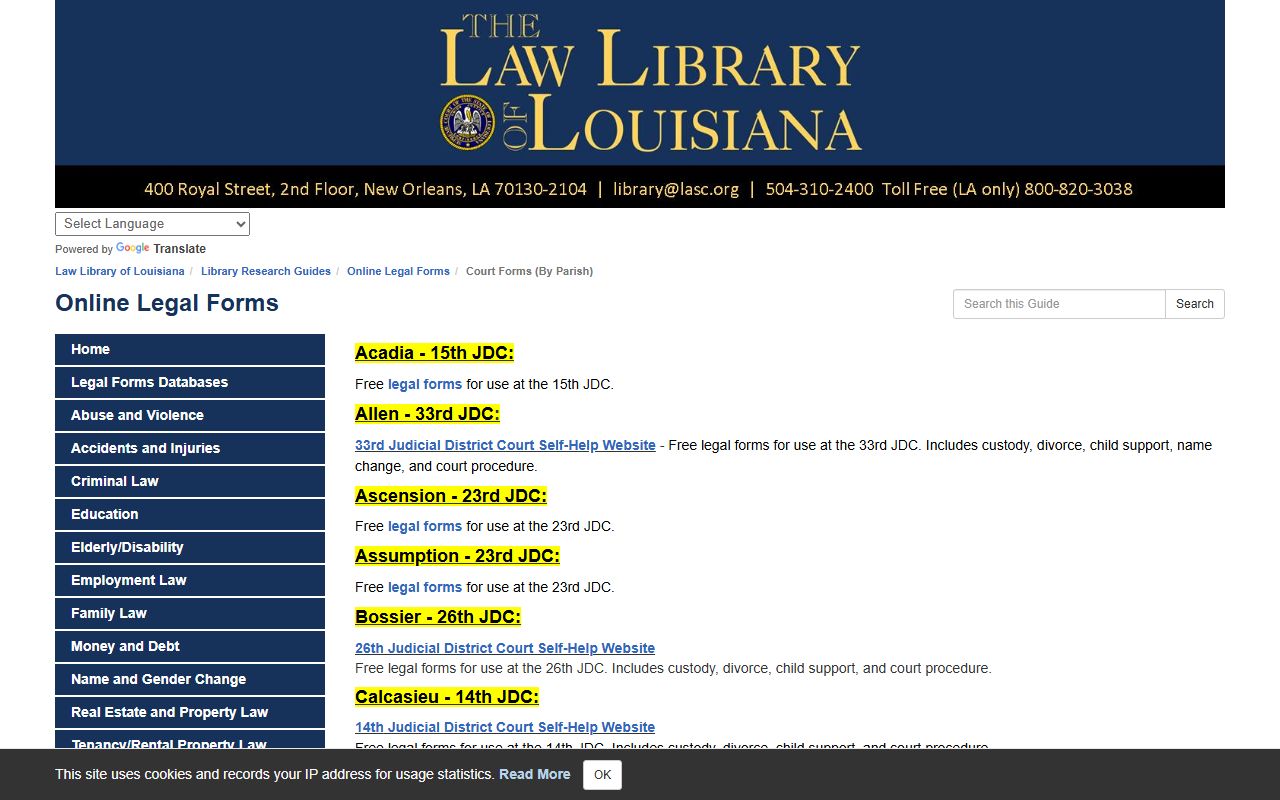
For legal help in East Carroll Parish, call 211 to connect with legal aid services that cover northeast Louisiana. The Louisiana State Bar family law resources include an attorney referral service. Louisiana Law Help offers self-help guides and forms for people who want to handle their own dissolution of marriage case without an attorney. The Law Library of Louisiana divorce guide is free and explains Articles 102 and 103 in plain language.
The Louisiana State Bar's online resources provide attorney referral links and family law guides for residents of East Carroll and surrounding parishes who need help with a dissolution of marriage case.
Louisiana Dissolution of Marriage Law
Louisiana uses "dissolution of marriage" in its Civil Code. Two no-fault paths exist. Civil Code Art. 102 lets you file a petition and wait. The wait is 180 days if there are no minor children, or 365 days if children are involved. After the waiting period, either party files for the final judgment. Civil Code Art. 103 covers cases where the parties have already been separated for the required period and can get the judgment faster. Art. 103 also allows fault-based dissolution on specific grounds.
A six-month Louisiana residency requirement applies before you can file. At least one spouse must be domiciled in Louisiana and in the parish where the case is filed. For East Carroll Parish, that means at least one spouse must live in the parish. The community property rules under Civil Code Art. 2325 govern how marital assets and debts are divided. Louisiana is a community property state, so assets and debts acquired during the marriage generally belong equally to both spouses. The final judgment must address this. Unresolved property matters can be handled later in a separate partition action.
East Carroll Parish is one of the smaller, more rural parishes in the state. The clerk's office is small, but the same state laws apply here as in any Louisiana parish. Filing fees, waiting periods, residency rules, and community property principles are the same statewide. The main difference between parishes is the specific clerk's office you contact and whether online access is available.
Nearby Parishes
East Carroll Parish is in the far northeast corner of Louisiana. It borders several other northeast Louisiana parishes. If you need to determine which parish holds your dissolution of marriage records, check where you or your spouse was domiciled when the case was filed.